
Rick and Morty S3 E5: The Whirly Dirly Conspiracy – Episode Summary and Overview
Overview of Season 3
“Rick and Morty,” the acclaimed animated science fiction series created by Justin Roiland and Dan Harmon, continues to push the boundaries of surreal storytelling and dark humor in its third season. Premiering on July 30, 2017, this season delves deeper into the complex relationship between the eccentric, genius scientist Rick Sanchez and his easily influenced grandson, Morty Smith. The show explores themes of existentialism, family dynamics, and the consequences of reckless intelligence.
Related Telegram Channels

Rick and Morty S1 E10: Close Rick-counters of the…
Rick and Morty S1 E6: Rick Potion #9 Watch Free in Telegram
Rick and Morty S3 E3: Pickle Rick – Watch Free on Telegram
Rick and Morty S1 E5: Meeseeks and Destroy – Watch…
Rick and Morty S3 E6: Rest and Ricklaxation – Watch…
Rick and Morty s1 e3: Anatomy Park Watch Free in Telegram

Season 3 is marked by a notable evolution in character arcs, particularly in the increasingly tumultuous relationship between Rick and Morty, as well as the introduction of more profound emotional undercurrents and established narrative structures. The season showcases a variety of inventive adventures, incorporating social commentary and existential dilemmas, culminating in the character development that has captivated audiences.
Episode Summary: “The Whirly Dirly Conspiracy”
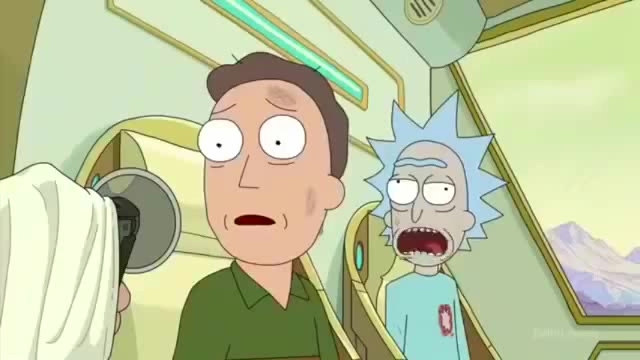
“The Whirly Dirly Conspiracy,” which is the fifth episode of Season 3, epitomizes the show’s characteristic blend of humor, absurdity, and dark philosophical themes. The episode begins with a premise that seems simple enough: Rick takes Jerry, Morty’s father, to a whimsical amusement park called the “Whirly Dirly.” This attraction features a long-standing reputation for being safe, with an innovative, limitless ride experience. However, the catch is that any visitors to the park forfeit their mortality while they are inside—an enticing prospect for the thrill-seeking but also inherently dangerous.
The episode starts on an amusing note as Rick reluctantly agrees to spend time with Jerry, despite his level of disdain for him. However, as the story unfolds, it becomes apparent that Rick’s motivations are far less about familial bonding and more about the results of a scientific experiment involving the park’s bizarre technology—essentially weaponizing it to keep Jerry distracted while pursuing his operations.
The plot thickens when Morty and Rick burn the midnight oil trying to cover up a series of events that showcases Jerry’s naive belief in the park’s safety. Meanwhile, there’s a dramatic twist featuring a group of “life” entities, who want to take matters into their own hands after experiencing mortality-defying accidents. High stakes arise as Jerry unwittingly becomes drawn into the roller coaster of risky situations that ensue, resulting in laugh-out-loud moments but also ponderous reflections on the nature of life and death.
At the heart of the episode is an exploration of self-awareness, identity, and the fragility of human life. The absurdity of the immortal ride pushes the characters into existential crisis, serving as a commentary on life’s unpredictability and the folly of taking mundane safety for granted. Audience members are treated to the Brinkmanship that exists in the realm of science and mortality, wrapped in the series’ signature wit.
The episode addresses Jerry’s ongoing struggles for validation and his often inept attempts to garner Rick’s approval. Ultimately, Rick’s dismissive attitude towards Jerry contrasts starkly with a fleeting admiration for Morty’s more astute awareness of their surroundings and the difficulties of family relationships.
While delivering laughs, “The Whirly Dirly Conspiracy” also elicits a more somber contemplation regarding maturity, self-awareness, and the consequences of one’s actions. Rick’s internal conflicts emerge as he is dragged into destructive choices, hinting at an ongoing battle within him as he grapples with the ramifications of his scientific explorations.
By the episode’s conclusion, crises are avoided, but lingering questions about morality and identity are left to haunt not only the characters but also the audience. With its compelling mix of humor, unique narrative structure, and thought-provoking themes, “The Whirly Dirly Conspiracy” stands out as a memorable episode in a season that constantly challenges viewers’ perceptions of intelligence, family loyalty, and the complexities of existence. Each adventure tightens the web of relationships, increasing both the stakes and the emotional weight carried by the characters as they navigate their increasingly chaotic lives.
In summation, “The Whirly Dirly Conspiracy” exemplifies the charm and depth of “Rick and Morty,” merging comedic brilliance with philosophical inquiry, leaving fans once again delving into discussions about the nature of existence, science, and the bonds that tie families together.